The DFW Office Is Back. And Employees Expect More
Dallas-Fort Worth is the country's leading return-to-office market. Office busyness in the metro hit nearly 87% in October 2025, per Avison Young's Office Busyness Index, and the Dallas Central Business District and Uptown submarkets pushed past 106% of pre-pandemic use. Home Depot mandated a full five-day return for corporate staff starting April 6, 2026. PNC Financial followed suit on May 4. Charles Schwab, AT&T, American Airlines, State Farm, and Toyota, all headquartered or major-campused in DFW, have all moved off hybrid in the last eighteen months. The pattern is clear: the office is back, Tuesday through Thursday is nearly full, and employees coming in expect more than they left behind.
That last part is where most DFW offices are getting caught flat-footed. Employees who spent four years controlling their own breakroom, their own coffee, their own snacks, their own fridge, are not coming back to a 1990s vending machine stocked with Mountain Dew and Snickers. They are not coming back to an empty breakroom with a broken Keurig. The breakroom has gone from a non-issue to an amenity employees actively evaluate. It is part of the RTO negotiation.
This guide is for the office managers, HR directors, facility managers, and operations leads inside DFW tenant companies who are responsible for making the office feel worth coming back to. If you have 30 or more employees in a single location, or fewer than 30 but high client and visitor traffic, a properly designed vending program will do more for morale and retention than almost any other amenity you can add at the price.
What DFW Office Workers Actually Buy in 2026
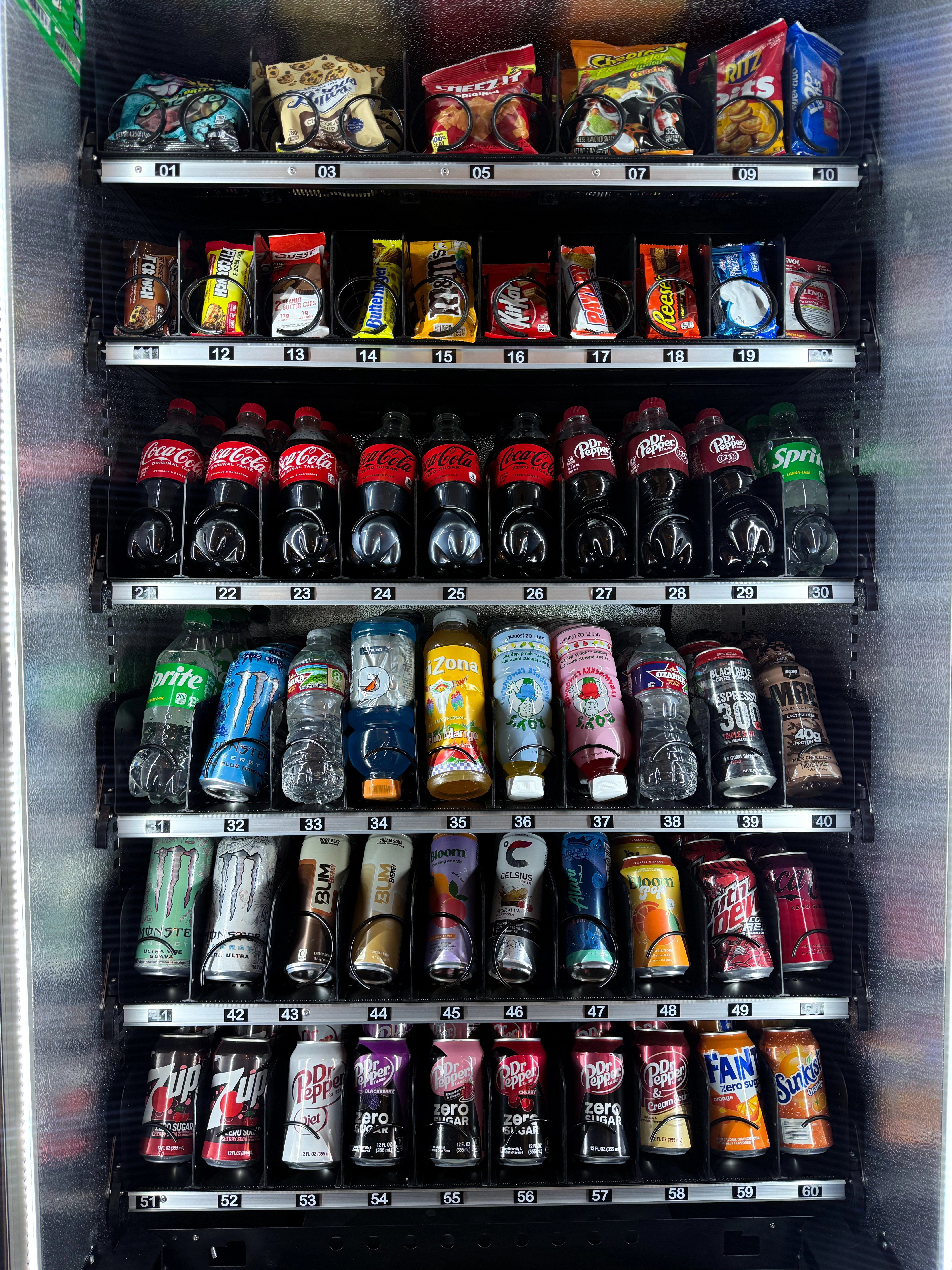
The office vending product mix has changed more in the last three years than in the twenty years before that. If your current machine is stocked with regular Coke, Snickers, and Lay's Classic. It is losing to the drugstore on the corner, the coffee shop on the ground floor, and the employee's desk drawer full of their own snacks.
The categories that are moving in DFW offices right now:
Functional and Performance Beverages
Celsius, Ghost Energy, Alani Nu, and Bloom have become the dominant energy drink SKUs in modern office vending. They sell to the 25–45 demographic that dominates most DFW office buildings, health-conscious enough to avoid Red Bull and Monster, caffeine-dependent enough to need something beyond coffee. A single well-placed Celsius slot in a tech or finance office will often out-sell every other drink in the machine.
Hydration and Recovery
Liquid IV packets, Electrolit, Gatorade Zero, and Fairlife Core Power have become staples in DFW offices, particularly in companies with on-site fitness facilities or active employee populations. Essentia and Core Hydration have pushed premium bottled water from a niche product to a routine purchase, office workers will pay $2.75 for hydration they trust over $1.25 for a generic bottle.
Protein-First Snacks
Barebells, Quest, RXBAR, and the newly launched Ghost Protein Bars have replaced candy bars as the default office snack. Chomps jerky, Perky Jerky, and Kind Protein bars capture the savory protein slot. The shift is structural, employees buying mid-afternoon want something they can justify, not something they will regret by dinner. A machine stocked with 60% protein-forward options will outperform a traditional snack mix in almost any DFW office demographic.
Prebiotic and Functional Sodas
Olipop and Poppi have genuinely shifted the soda category. In DFW offices with younger workforces, prebiotic soda slots now move faster than regular Coca-Cola. The margin is higher, the demographic match is better, and the perception is that of a modern, thoughtful employer. We have placed Olipop in tech offices in Legacy West and Uptown where it sells out between restocks.
Coffee Alternatives and Cold Brew
Canned cold brew from Chameleon, La Colombe, and Starbucks Doubleshot has become one of the fastest-moving categories in office vending. The use case is specific: the employee who needs an afternoon caffeine hit but does not want to walk to the lobby coffee shop, brew a fresh pot, or drink the hours-old pot sitting in the breakroom. Canned cold brew is the fix, and it moves at premium prices.
What Is Declining
Regular Coca-Cola and Pepsi are in retreat in DFW offices. Basic milk chocolate candy bars move slower than they did even two years ago. Plain potato chips without flavor differentiation sit in slots. If you walk into a DFW vending machine and the top two rows are full of products that would have sold in 2005. Your operator has not updated their planogram since then, and your employees have noticed.
The Revenue Math for DFW Office Vending
One of the most common questions we get from DFW office managers is some version of "is a vending machine really worth the breakroom space?" The honest answer depends on your headcount, your foot traffic, and your operator's ability to stock the right products.
The benchmark number in the industry is roughly $8 per employee per month in gross vending sales at a well-placed office machine. That is not a guarantee. It is an average across offices running properly curated product mixes with cashless payment and reliable restocking. Poorly stocked machines in offices with distracted operators land closer to $3 per employee. Machines in tech offices with premium product mixes and subsidized programs can push past $15 per employee per month.
Practically, that means:
30 to 50 Employees
A single combo machine with weekly restocking. Gross sales in the $240 to $400 per month range at standard pricing. This is the threshold where vending starts to make structural sense, enough traffic to justify the restock route, enough employees to keep products moving before they expire.
50 to 100 Employees
A combo machine with restocking one to two times per week. Gross sales in the $400 to $800 range. At this size. You have room to think about product customization, a targeted protein-heavy mix for an active workforce, or a premium beverage focus for a client-facing office.
100 to 200 Employees
Either a single high-capacity combo machine with twice-weekly restocking or a two-machine configuration (one snack, one beverage) for better variety. Gross sales in the $800 to $1,600 range. This is the sweet spot where a subsidized vending program starts to look genuinely valuable.
200+ Employees
Multi-machine configurations, three-times-weekly restocking, and typically a conversation about subsidized programs or fresh-food machines. Gross sales in the $1,500 to $4,000+ range depending on product mix and employee density.
Why Micro Markets and Smart Coolers Fail in DFW Offices
If you have been pitched a micro market or an "AI smart cooler" for your DFW office. You have almost certainly heard the same three claims: more variety, better experience, and self-checkout convenience. What you have not been told is the theft number, and it is the number that matters most.
Micro market operators report industry-wide shrinkage between 3% and 5% of gross revenue. That is the polite term for theft. On a $1,000-per-month micro market. That is $30 to $50 in inventory walking out the door every single month. On a $3,000-per-month installation. It is $90 to $150 per month. The operator either absorbs the loss and cuts service quality, raises prices to cover it and makes your breakroom more expensive than the CVS downstairs, or cancels the installation entirely after six months.
How the Theft Actually Happens
Micro markets are open retail. Products sit on shelves or inside unlocked coolers. Customers are expected to scan every item at a self-checkout kiosk and pay honestly. In an office setting, where everyone knows everyone. The theft is rarely malicious. It is easier than that.
Someone grabs a protein bar in a hurry, forgets to scan it, and walks out. Someone scans a $1.25 bottle of water and takes a $4.50 energy drink. Someone "means to come back and pay" for the chips they grabbed during a phone call and never does. A single employee with sticky fingers can normalize the behavior for a whole floor, and suddenly what started as accidental becomes culture. The operator sees a 5% shrinkage number and eventually decides the account is not profitable.
Why Smart Coolers Are Not the Solution
Smart coolers and AI vending machines are marketed as the answer to micro market theft. The pitch is that a card tap unlocks the fridge, AI cameras track what comes out, and the customer is charged automatically. The reality is more complicated, and more vulnerable.
A prepaid gift card loaded with five dollars is enough to unlock a smart cooler. Once the door is open. The shelves are open. Cameras have blind spots. Weight sensors drift out of calibration. The authorization hold against the card clears, the customer walks away with $80 of inventory, and the operator absorbs the loss. Industry coverage of smart cooler deployments has documented this exact exploit repeatedly. The honor system with a technology layer on top is still the honor system.
Why Vending Machines Solve This Structurally
A vending machine is a locked, secure transaction system. One payment dispenses one product. The customer pays, the machine vends a single item, and the transaction is complete. There is no open shelving, no unlocked cooler door, no opportunity for a bad actor to drain an entire inventory in thirty seconds. This is not a marketing claim. It is the structural reason vending has survived for over a century while open-shelf retail concepts come and go.
This is why EJR Vending does not operate micro markets or AI smart fridges anywhere in the Dallas-Fort Worth Metroplex. We will not build our clients' refreshment programs on an honor system that assumes every employee and every visitor is honest.
The Subsidized Vending Option (And When It Is Worth It)
One of the most underused tools in office amenity programs is subsidized vending, and it deserves a serious look if you are trying to make the office feel worth coming back to.
Subsidized vending is straightforward. The employer covers a portion of each transaction, 30%, 50%, or 100% depending on the structure, and employees pay the rest. The machine runs the same way, but the price displayed at the reader is the subsidized amount. From the employee's perspective. It is a real, tangible perk. From the employer's perspective. It is one of the highest-ROI amenity programs you can offer.
Common Subsidy Structures
The three most common setups we deploy across DFW are:
Partial subsidy across the whole machine. The employer covers a flat percentage, typically 30% to 50%, of every transaction. Simple, predictable, and easy to budget. Volume typically increases two to three times over a non-subsidized machine.
Full subsidy on wellness products only. The employer covers 100% of the cost of specific healthy items, bottled water, protein bars, functional beverages, while employees pay full price for indulgent items. This is popular with companies running wellness programs or HR initiatives around employee health.
Per-employee monthly credit. Each employee gets a set amount of vending credit per month ($20, $30, $50) loaded to a cashless account. They use it however they want. The employer has a hard cap on monthly spend and employees perceive real value. This is increasingly popular with tech companies and professional services firms in Legacy West, Uptown, and Las Colinas.
The Real Cost Math
A 50-employee office at 30% subsidy on $400 in monthly gross sales costs the employer $120 per month. That is $2.40 per employee in tangible amenity spend, less than one Starbucks run per employee, per month. For companies where the alternative is employees eating lunch out every day (at $15+ per meal) or skipping the office entirely for remote work, $120 a month is a rounding error.
We offer full subsidized vending program design to qualifying DFW offices. The program integrates with standard HR payroll systems, handles reporting automatically, and does not require the employer to manage any aspect of the machine or the inventory.
What Actually Makes a Great Office Vending Program in 2026
The national chains. Canteen, Aramark, Compass Group, will tell you they offer "nationally consistent service" and "integrated breakroom solutions." What that means in practice is that a 50-employee DFW office is account number 12,847 on a route driver's list, and your service level is whatever is left after the 2,000-employee corporate campus gets its attention.
A great office vending program in 2026 requires:
Product Curation Matched to Your Demographics
A tech office in Legacy West wants different products than a healthcare back-office in Las Colinas. A law firm in Uptown wants different products than a logistics operation in Alliance. A good operator walks your office, asks your employees what they actually want, and designs a planogram specific to your building. A bad operator loads the same planogram into every machine on the route.
Cashless Everything
Cashless transactions now account for 70% of vending industry sales, up from 69% in 2018, and the trend is accelerating. Apple Pay support alone has been documented to drive 22% revenue growth over cash-only machines. The average credit card transaction at a vending machine is 37% higher than the average cash transaction. If a vending operator is pitching you a machine in 2026 without full Apple Pay, Google Pay, Samsung Pay, and contactless NFC support. They are pitching you 2015 equipment.
24-Hour Service Response
The number one complaint in office vending, consistently, across every survey and every Reddit thread, is slow service response. Machine jams, card reader failures, and empty slots are not catastrophes. They become catastrophes when the operator takes a week to show up. A DFW-based operator with local technicians should be able to respond to any service request within 24 hours. If the answer is "we will get to you next week," you have the wrong operator.
Flexible Month-to-Month Contracts
The old industry standard was a three- or five-year vending contract with automatic renewal clauses. Those contracts protected the operator, not the office. A modern vending operator should be willing to work on month-to-month terms, with no long-term lock-ins, because they are confident enough in their service to earn your business every month.
Telemetry-Monitored Inventory
A machine should never sit empty. Modern vending machines report inventory levels back to the operator in real time, flagging low slots before employees notice. If your current operator is relying on a route driver to physically check your machine once a week. You are going to have empty slots on Fridays. A telemetry-monitored machine restocks before the problem appears. This is standard equipment at EJR Vending and it is what separates a professional operator from a hobbyist with a route.
Modern Machine Aesthetics
The beige 1990s vending machine is a brand liability. It tells every candidate who interviews at your office that your facilities team has not thought about the breakroom in twenty years. Modern vending equipment is sleek, dark, professionally branded, and does not look out of place in a premium office building. Equipment aesthetics are part of the employee experience, not an afterthought.
Why DFW Offices Fire Their Vending Operators
The common denominator in every "we need to find a new vending operator" conversation I have with DFW office managers is some combination of the following:
Machine downtime with no response. The machine has been broken for three days. Someone called the operator. Nobody has called back. Employees are complaining. The office manager is embarrassed. This is the single most common reason offices switch operators, and it is entirely preventable.
Expired products sitting in slots. A protein bar with a 2024 date. A Gatorade from six months ago. Stale chips. Expired products signal that the operator is not rotating inventory, not checking their own work, and not paying attention to your account. If you cannot trust the date on the product, you cannot trust the operator.
The hollow machine problem. Half the slots are empty. The other half are stocked with products nobody wants. This is a restock-frequency problem and a product-curation problem. Both are the operator's fault and neither should happen twice at the same account.
Manual refunds. Employees lose money to the machine and have to submit receipts to HR for reimbursement. A modern operator handles refunds directly through the cashless payment system, no paperwork, no manual process, no burden on your admin staff.
Product mix that does not match demographics. Kids' candy in a law firm. Diet products in a logistics warehouse. Energy drinks that nobody in the building has heard of. Wrong-product-mix complaints are almost always a sign that the operator has not walked the office, never asked employees what they want, and never updated the planogram since installation.
Long-term contracts. The office wants to switch operators but cannot because the contract has 18 months left and includes an automatic-renewal clause. This is predatory. A good operator earns your business month to month, they do not lock you in and coast on the contract.
Who This Is For, and Who It Is Not
Honest qualification is more useful than broad marketing, so here it is.
Office Vending Makes Sense For:
Offices with 30 or more employees in a single location. This is the threshold where machine economics hold up, enough daily transactions to justify route restocking, enough product velocity to keep inventory fresh, and enough employee density to generate meaningful revenue.
Smaller offices with high foot traffic. "High traffic" does not mean "we have a lot of meetings." It means your 20-person office gets 50+ visitors a day, a medical practice with patient flow, a financial advisor with back-to-back client meetings, a creative agency with a shared reception serving multiple tenants. If your office has more daily visitors than employees, you qualify even if your headcount is low.
Multi-floor offices with distributed breakrooms. Each floor can have its own machine, each machine is independently telemetry-monitored, and the configuration scales with building headcount.
Companies that have mandated full return-to-office. RTO increases breakroom demand dramatically, employees who used to eat lunch at home are now eating at the office five days a week. Vending demand scales with in-office density. If your Tuesday-Thursday density is above 70%, vending will perform.
Office Vending Does Not Make Sense For:
Offices under 20 employees with low traffic. The economics do not work. A route driver cannot justify a weekly restock for a handful of transactions. You will be better served by a small pantry program or a subscription snack box like SnackNation or Caroo, and we will tell you that directly if you reach out for a site assessment.
Offices with existing daily catered lunches. If your company already provides catered breakfast, lunch, and afternoon snacks, a vending machine is competing for wallet share that does not exist. Vending and catering coexist in some offices, but only when the catering is limited to specific days or specific meals.
Fully remote or low-density hybrid offices. If your Tuesday-Thursday density is under 40%, the machine will sit empty most of the time and products will expire faster than they sell. Vending economics require people in the building.
National Chains vs. Local DFW Vending Operators
If you are a 50-to-200-employee DFW office. You are a small account for a national vending chain. You will not get the premium product curation, you will not get the fastest service response, and you will not get a named account manager. You will get whichever route driver happens to be in the area, running the same planogram they load into every account on the route.
A local DFW operator is structurally different. Our route drivers drive past your office every week regardless. Our service technicians are based in the Dallas-Fort Worth metroplex, not dispatched from a regional hub in another state. Our account managers know your name, your industry, and what your employees actually buy, because we placed the machine there ourselves and we walk the account regularly.
This is not an abstract advantage. It is the difference between a broken machine fixed in four hours versus four days. It is the difference between a quarterly planogram refresh based on actual sales data versus the same national planogram for two years. It is the difference between flexibility and a three-year contract with a termination clause.
We have written more on the local-versus-national question elsewhere, but the short version for office managers: if your office is under 500 employees, a local operator will out-service a national chain every single time.
Getting Started with EJR Vending for Your DFW Office
If you have read this far. You are probably already thinking about whether your current office vending situation is working, or whether your office needs vending in the first place. The next step is a free site assessment.
Our site assessments are honest. We walk your office, talk to your employees, look at your foot traffic patterns, and tell you whether vending actually makes sense for your specific space. If it does, we design a machine configuration and product mix specific to your company's demographics. If it does not, we will tell you that too, and point you toward alternatives that fit better.
There is no cost to the assessment, no cost to install, and no long-term contract. We earn our placement every month through product quality, service response, and the kind of account management that national chains cannot scale. Contact EJR Vending to schedule a site assessment for your DFW office and we will show you exactly what your space qualifies for.