The Micro Market Pitch Sounds Great on Paper
If you have researched breakroom solutions for your DFW business recently. You have probably seen micro markets promoted as the future of workplace refreshment. The pitch is compelling: an open shelving unit stocked with 150 or more products, a self-checkout kiosk, fresh food options, and a convenience-store feel right inside your building. Some vendors add AI-powered smart fridges to the mix, using cameras and weight sensors to detect what you grab and charge your account automatically.
It sounds modern. It sounds premium. But behind the polished marketing, micro markets have a fundamental structural problem that no amount of technology has solved, and it is a problem that traditional vending machines eliminated decades ago.
The Security Problem Nobody Talks About
A micro market is an open retail environment. Products sit on shelves or inside unlocked coolers. Customers are expected to scan every item at a self-checkout kiosk and pay honestly. Smart fridges use a credit card tap to unlock the door, then rely on sensors to detect what was removed and charge accordingly.
Here is the reality that micro market vendors downplay: the entire model runs on the honor system. A single dishonest person with a prepaid card loaded with five dollars can unlock a smart fridge and empty every shelf inside it. The fridge registers a $5 authorization, the person walks away with $200 worth of inventory, and the operator absorbs the loss.
With open-shelf micro markets. The problem is even simpler. There is nothing stopping someone from grabbing items and walking past the kiosk without scanning. Industry data consistently shows that micro market theft runs between 2% and 5% of gross revenue. For a location doing $3,000 per month. That is $60 to $150 in stolen product every single month, a cost that either the operator eats or passes along through higher prices.
Vending Machines Solved This Problem Before Micro Markets Existed
A vending machine is a locked, secure transaction system. One payment equals one product. The customer pays, the machine vends a single item, and the transaction is complete. There is no honor system, no open shelving, no unlocked cooler doors, and no opportunity for one bad actor to wipe out an entire inventory in 30 seconds. This is not a minor advantage. It is the foundational reason vending has survived and thrived for over a century while open-shelf retail concepts come and go.
Why Micro Markets Get Pushed So Hard
Here is what micro market vendors will never tell you: the main reason they push micro markets over traditional vending is because micro markets are cheaper for the operator to deploy.
A modern commercial vending machine with cashless payments, refrigeration, and smart telemetry costs $3,000 to $8,000 per unit. To match a micro market's product variety. You need two to three machines. That is $6,000 to $24,000 in equipment. A full micro market setup with shelving, coolers, and a self-checkout kiosk can be deployed for $10,000 to $15,000. At scale, the operator's hardware investment is lower with a micro market, and that is exactly why they push them.
But the cost savings go to the operator, not to you. The operator spends less on equipment and you absorb the consequences: higher theft exposure, more space dedicated to their setup, internet dependency, and additional liability considerations. The operator's cheaper deployment becomes your more expensive problem.
When a micro market vendor tells you their solution is better for your location, ask yourself: better for whom? The economics favor the operator. The security, space efficiency, and reliability favor vending.
The Real Cost of Running a Micro Market
Micro market vendors often position their product as a free amenity, similar to free vending placement. But the economics are fundamentally different, and the hidden costs land on the host location.
Space Requirements
A micro market typically requires 100 to 250 square feet of dedicated floor space for shelving, coolers, a kiosk, and customer flow area. In a DFW commercial property where breakroom square footage is already limited, that footprint is significant. A vending machine occupies roughly 15 to 20 square feet per unit. Even a three-machine automated convenience store setup from EJR Vending takes less space than most micro markets while offering comparable product variety.
Infrastructure and Liability
Micro markets require dedicated internet connectivity for the self-checkout kiosk and smart fridge systems. If your building Wi-Fi goes down, the checkout system goes down with it. Some micro market operators require the host to carry additional liability coverage for the open retail environment, since customers are physically handling products off shelves rather than receiving them through a secure vend mechanism.
Vending machines operate on cellular telemetry, completely independent of your building network. They require nothing beyond a standard 120V electrical outlet. No internet dependency, no additional insurance requirements, no open inventory exposure.
Maintenance Complexity
A micro market has more failure points: kiosk touchscreens, payment terminals, refrigeration units with frequently opened doors, shelf sensors, cameras, and networking equipment. When any component fails, the entire market may become non-functional until a technician arrives.
A vending machine is a self-contained unit. If one machine in a multi-unit setup needs service, the others continue operating normally. EJR Vending provides fast local service response across our entire DFW fleet, and our telemetry systems flag mechanical issues before they affect customers.
Product Variety: The One Advantage That Is Not Actually Exclusive
The strongest argument for micro markets has always been product selection. A single vending machine holds up to 60 SKUs. A micro market can stock 150 or more. For locations that need serious variety, large workforces, 24/7 operations, mixed demographics, that gap used to be a real differentiator.
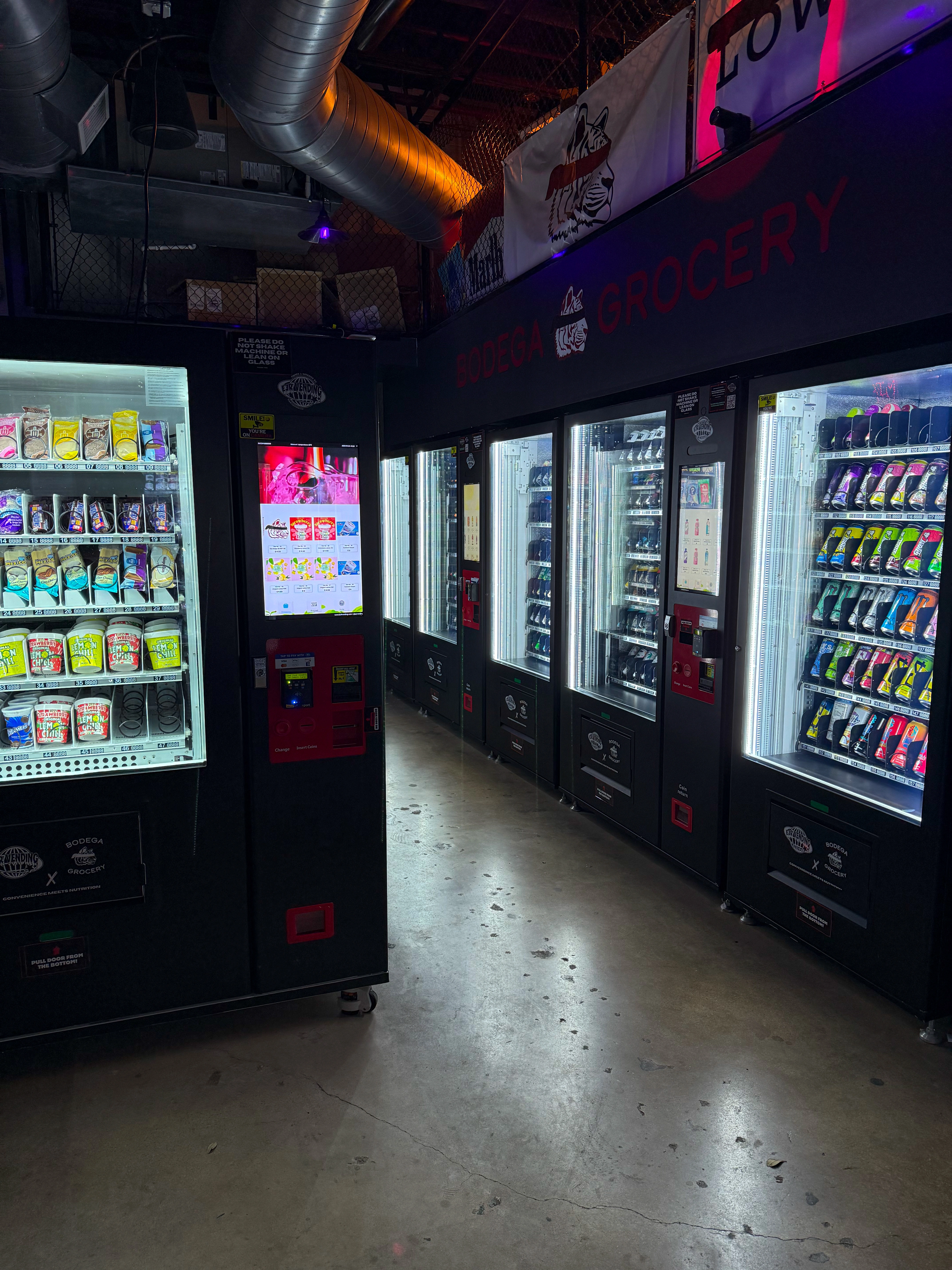
It is not anymore. Multi-machine vending configurations solve the variety problem without the security compromise. A two-machine cluster offers up to 120 products. A three-machine setup pushes past 180. EJR Vending's Bodega W. 7th in Fort Worth operates 15 machines as a fully automated convenience store, hundreds of products, 24/7 access, zero theft exposure because every single transaction is locked and secured.
The variety argument for micro markets only holds if you compare them against a single machine. Compare them against a properly designed multi-machine deployment and the advantage disappears.
Fresh Food: A Micro Market Staple With Caveats
Micro markets are often promoted for their fresh food options, sandwiches, salads, yogurt parfaits, and prepared meals displayed in open coolers. This is a genuine differentiator for some locations, but it comes with trade-offs.
Open cooler doors mean temperature fluctuation every time a customer browses. Fresh food carries higher spoilage rates and tighter expiration windows. If the micro market is in a location with inconsistent demand, slow Fridays, holiday weeks, seasonal dips, the operator either overstocks and writes off expired product or understocks and the shelves look bare.
Modern vending machines with refrigerated compartments maintain consistent temperatures because the door only opens during a completed transaction. Spoilage is lower. Temperature integrity is higher. EJR Vending deploys fresh food and frozen meal machines across DFW healthcare facilities and warehouses that need hot meal and cold meal options without the waste profile of an open cooler.
Why EJR Vending Does Not Operate Micro Markets or AI Fridges
We get asked about micro markets regularly. Property managers see them trending on LinkedIn and want to know if we offer them. The answer is no, and we are transparent about why.
We do not operate any product on the honor system. Period. The theft exposure is not theoretical. It is a documented, measurable cost that every micro market and smart fridge operator absorbs. One nefarious customer with a prepaid gift card can cause more inventory loss in a single visit than a vending machine experiences in an entire quarter. We are not willing to accept that risk, and we are not willing to pass it along to our DFW clients through inflated pricing or reduced service quality.
Instead, we solve the variety problem the right way: multi-machine configurations that match or exceed micro market product counts while maintaining 100% transaction security on every single item. Every machine in our fleet is locked, cashless-ready, and remotely monitored. No honor system. No theft.
Side-by-Side Comparison
Security
Micro markets rely on the honor system with 2% to 5% average theft rates. Vending machines are locked and secured, one payment, one product, zero theft.
Space Required
Micro markets need 100 to 250 square feet. A single vending machine needs 15 to 20 square feet, and a three-machine cluster needs roughly 50 to 60 square feet.
Product Variety
A single micro market offers 150 or more SKUs. A single vending machine offers up to 60. A multi-machine cluster matches or exceeds micro market variety at 120 to 180 or more SKUs.
Internet Dependency
Micro markets require building Wi-Fi for kiosk and payment systems. Vending machines use independent cellular telemetry with no building network required.
Fresh Food
Micro markets use open coolers with higher spoilage risk. Vending machines use sealed refrigerated compartments with consistent temperature control.
Upfront Cost to Host
Both can be offered at zero cost to the host location through operator-managed programs.
Theft Exposure
Micro markets have high exposure with no physical barrier to product access. Vending machines have zero exposure. Product is physically locked until payment clears.
The Right Choice for DFW Businesses
If you are evaluating breakroom or lobby refreshment options for a DFW property. The question is not whether micro markets look nicer on a brochure. The question is whether you want your refreshment program built on a locked, proven transaction model or an honor system that assumes every person who walks through your building is honest.
EJR Vending deploys modern, cashless-ready vending equipment across the Dallas-Fort Worth Metroplex. Whether you need a single machine for a small office or a multi-machine automated convenience store for a high-traffic property, we design the configuration to match your space, your foot traffic, and your product needs.
No honor system. No theft. No open shelves. Just a secure, fully managed vending program that works. Contact EJR Vending for a free site evaluation and we will show you exactly what your location qualifies for.